Showing posts with label decay. Show all posts

Sunday, 27 May 2012

Building Without Hope


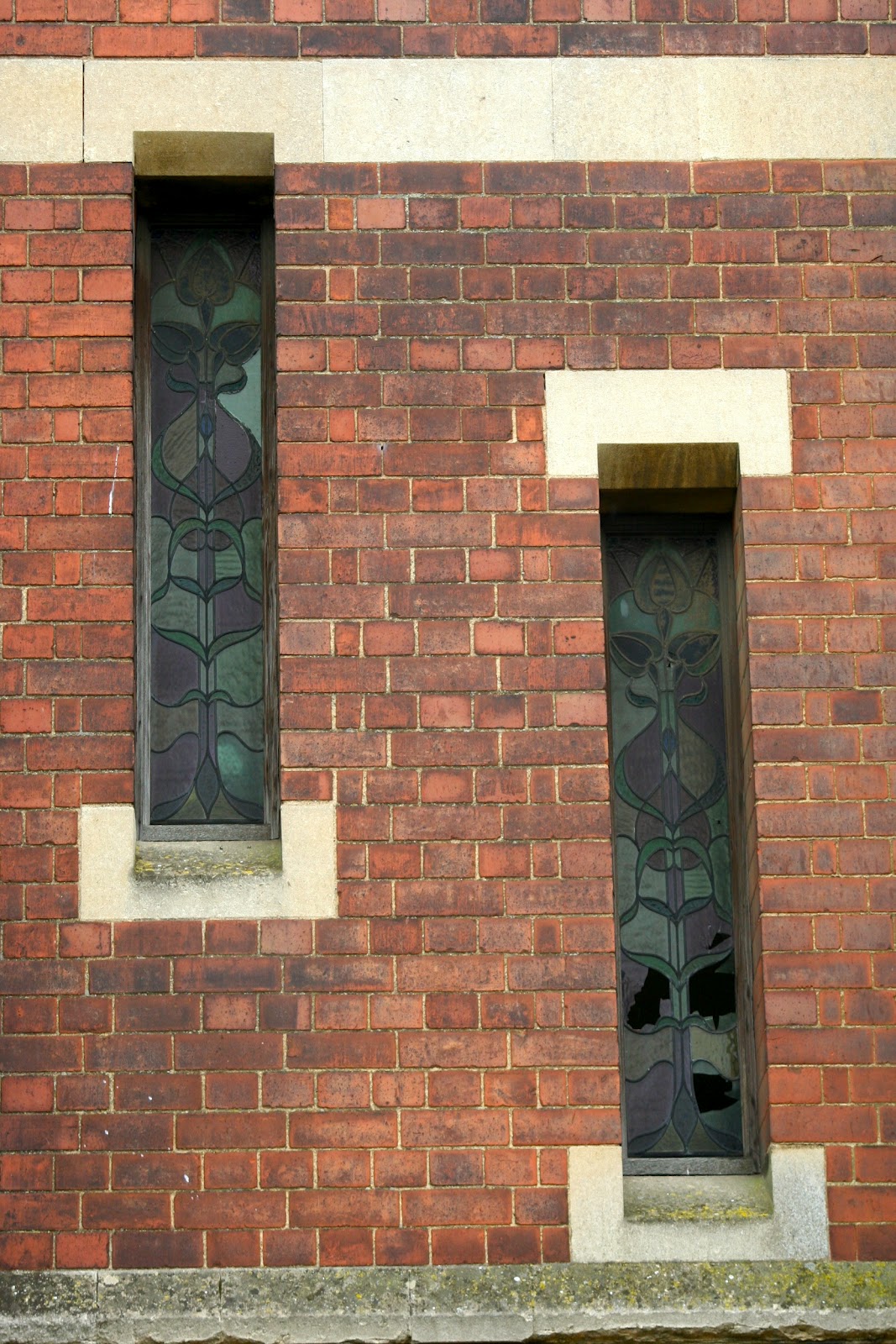
This poor building is the Methodist Church in Higham Ferrers which was built in 1902 / 03 by architect Thomas Dyer, over the years I have watched it fall further and further into disrepair. I can never understand why empty buildings have their windows smashed and I would have loved to see these ones from the inside, with the light shining through them. I made some enquiries but sadly the building is now in such a dangerous state that it is impossible to view the interior and apparently everything that could be stripped out has been stripped by those that prey upon empty buildings. The former congregation now worship in Rushden and have been caught in a difficult situation. They tried over the course of many years to raise the funds to have the necessary repairs made to this church and now it is too late. Apparently they hope to sell their church in Rushden which will release the funds to demolish the Higham Ferrers church building. The site will be used to build a modern, multipurpose place of worship which will also have spaces for community use.

Plans for demolition were first agreed in 2004 and there seems to be an artists impression of what the proposed replacement church building might look like on the Making Hope A Certainty website

There are some interesting facts about the Methodist Circuit and the plans for the new church which was recorded on the Rushden Research website in 2007.

You can read an article by The Victorian Society about the demolition plans and the controversy it raised in 2008 by following the link

There is an entry in the Directory of British Architects for Thomas Dyer 1872 - 1908 born in Wiltshire but resident in Northampton in the 1900's


Wednesday, 30 November 2011

The Butterfly Net & The Bottle Cage

During one of my Snibston visits I brought my friend Sarah with me as I though she would really enjoy the diverse nature of the collections to be found in the museum. 
Together we tested out all of the interactive elements we could find. The skeletal cyclist and the plasma ball were particularly enjoyable.
On the same visit we spoke to John on the front desk and asked him to tell us more about the work of the miners and the nature of the community that existed before the pit closure. He had been in the navy and when he left he became a miner. He told me that it was “the best, the funniest, the hardest job” and he had loved the camaraderie he shared with his workmates.
He told us about an old mining tradition – when a young man started in the mine he would cut a piece of wood from a beam and take it home as kindling. This kindling was known as cock wood. I was curious about the role the women played in the community and he said they really ruled the roost as they looked after the money, kept the home and hearth going.
This made me think about the male and the female, the mining and the fashion collections and also of the symbolism of the Earth Mother which Encyclopedia Britanica describes as follows:-

"Earth Mother,  in ancient and modern nonliterate religions, an eternally fruitful source of everything. Unlike the variety of female fertility deities called mother goddesses, the Earth Mother is not a specific source of vitality who must periodically undergo sexual intercourse. She is simply the mother; there is nothing separate from her. All things come from her, return to her, and are her.
The most archaic form of the Earth Mother transcends all specificity and sexuality. She simply produces everything, inexhaustibly, from herself. She may manifest herself in any form. In other mythological systems she becomes a more limited figure. She becomes the feminine Earth, consort of the masculine sky; she is fertilized by the sky in the beginning and brings forth terrestrial creation. Even more limited reflections of the Earth Mother occur in those agricultural traditions in which she is simply the Earth and its fertility."
At times I have I felt as though I've been moving through the museum like a child with a butterfly net, capturing ideas. Some thoughts are half-formed, slipping away as soon as I try to net them, whilst others shift and change  making different strings of meaning, leading me to more thoughts and ideas.
I am intrigued by the idea of connecting the male and the female, the mines and the corsetry, lightness and weight, fragility and strength. Coal and corset are also potent instruments of change and transformation. 
I've been contemplating layers, above and below, inside and outside (garment / mineshaft), power (mining, heat, energy, finance, status), tunnelling through - from soft surface to hard hot darkness. The pipes that carry heat, air or water have also been on my mind.
Then there are thoughts about the corset as support structure – like beams inside mines – holding the body up whilst creating a confined space inhabited by the body. I have been making visual notes to myself, trying to retain every spark that has been ignited by this journey.
The shift is still important, it lays beneath the corset giving the memory and illusion of freedom. Once the corset is removed, movement is freer but support is diminished. The mine shaft and the work of the miners share a similar dichotomy, the work is dangerous, the spaces are confining, yet the money earned, the skills required and the closeness of the workers offer certain freedoms. 
When I asked John what effect the pit closure had on Coalville and he said without the pit work the miners no longer bought their twist of tobacco from the tobacconist, their quarter of sweets from the sweetshop, their loaf of bread from the baker, it wasn’t only jobs that were lost, many other businesses were wiped away as livelihoods were intimately connected. 


Sunday, 20 November 2011

Growth and Connections - Some Thoughts

Snibston Visit One - Part Two
Growth and nourishment are vital to life and creativity
Cabbages growing outside Barber-Swindells 
When studying English at school we had to read a story, The Wharf by Walter De La Mare which has often come back to me in later life, particularly when seeing vegetation (plants or weeds) sprouting out of the most unlikely places. In the story a young mother is sent to a farm to convalesce, it sounds as though she has had a breakdown, her nerves are in a very fragile state and the world has become a terrifying place. She hasn't been sleeping, her appetite has vanished, she can't connect with the joy and brightness of her own child. This is the only quotation I could find for the story
"Confronting her, farther down the wharf, and moored to it by a thick rope, floated on the river a huge and empty barge. There was a wrapped figure stooping there, where the sweeps jut out, as if in profound Sleep. And above the barge, on the wharf itself, lay a vague irregular mass of what had apparently come out of the barge. It was at the spectacle of the mere shape of this foul mass, it seemed, that she had begun to be afraid. It would have horrified her even if she had been alone in the solitude of the wharf"
From what I recall, the "foul mass" is a large pile of horse manure and it seems to conjure up all of her fears about mortality and death. I can't remember the entire plot but what stayed with me most vividly was her reinterpretation of the spoil heap towards the end of the story. With the arrival of spring she notices that flowers (weeds?) are starting to grow on top of the heap and the Farmer explains the part  the manure plays in the cycle of life and fertility. She is able to look at the world differently, she is able to go home and resume her life.
Things decay but out of decay new life is possible.

I was struck by the message on the front of the crumbling milk float

As part of his Residency Paul Conneally created a piece called Three Jars of Coal Dust Jelly as part of his Spoilheap Harvest which again made me think of this quotation, particularly relevant today


 Walking round the scrap yard at Snibston it was
possible to identify much poignancy, beauty in decay. 
How can I use this to create something new?
Possibly by making connections 
between the literal and the abstract
Site intervention - Judo Belts - Steve Swindells